


Around this time of year, a renter’s browser tabs fill up with flight deals, family recipes, and gift guides, and that floor plan they saved in October gets buried in a long and growing “forget about this until after the holidays” list.
The slow season is here, and it looks a little different this year. Apartments are taking 36 days to lease, the longest October since Apartment List began tracking it in 2019. When renters take that long to decide, the prospects already on your list are your best shot at a lease, as long as you stay in front of them while they make up their minds.
To see what keeps winter renters engaged, we analyzed 1,013 multifamily email campaigns we sent on behalf of apartment communities from September 2024 through October 2026. The biggest lesson? When you hit send matters more than what your subject line says.
How Can Property Managers Use Email to Maintain Traffic During Slow Leasing Seasons?
Property managers can keep traffic coming in during slow leasing seasons by emailing the leads already in their pipeline. To stay in front of renters until they’re ready to tour, send segmented one-time email blasts to cold and warm leads, set up automated drip campaigns for every new lead, and save your best offers for the windows when renters are most likely to act.
When searches, website traffic, and new leads all dip in winter, apartment email marketing gives you a way to keep tours and leases moving without waiting for new demand to show up.
That matters more this year because renters are taking their time and have more options. As of January 2026, 54% of renters were still searching with low urgency, according to Apartment List, and those just-browsing renters take nearly three months to lease, compared with about six weeks for renters in a hurry.
Meanwhile, 40.4% of rentals on Zillow offered a concession in October, and Apartment List found that nearly a third of properties (32%) are offering one month free or more. A renter comparing that many deals isn’t going to remember the community that went quiet after their initial inquiry. Steady, useful email is how you stay on their shortlist until they’re ready to move.
Two Email Strategies to Keep Apartment Prospects Engaged
Effective property management email marketing in winter comes down to two tools that do different jobs: blasts that reach your whole list at once, and drips that follow up with each new lead automatically. To get the most out of email marketing this season, we suggest using both.
Email Blasts Re-Engage Leads Already on Your List
Email blasts are one-time campaigns sent to your lead list or a segment of it, and they’re the right tool for anything new: a leasing special, updated availability, an event, or a seasonal community update.
Because blasts often reach older leads, their click rates naturally run lower than a drip’s. Their job is to keep those leads warm until they’re ready to move, and our data shows rhythm makes a real difference:
- Monthly is the sweet spot. Properties that emailed their list with an email blast about once a month had the highest click rates of any sending rhythm (about 7%-16% higher) and the lowest opt-out rates (about 17% to 35% lower).
- Long silences cost you. When a list went more than two months without an email, opens dropped 5% to 8%.
Automated Drips Nurture New Leads
Automated lead nurturing drips start the moment someone converts on your website, whether they scheduled a tour, claimed an offer, or asked a question.
Click rates can be much higher (we’ve seen examples among our Conversion Cloud clients with drip CTRs running six to seven times higher than a typical blast). However, it’s important to monitor opt-outs, as they can run higher than blasts due to the frequency of the campaigns.
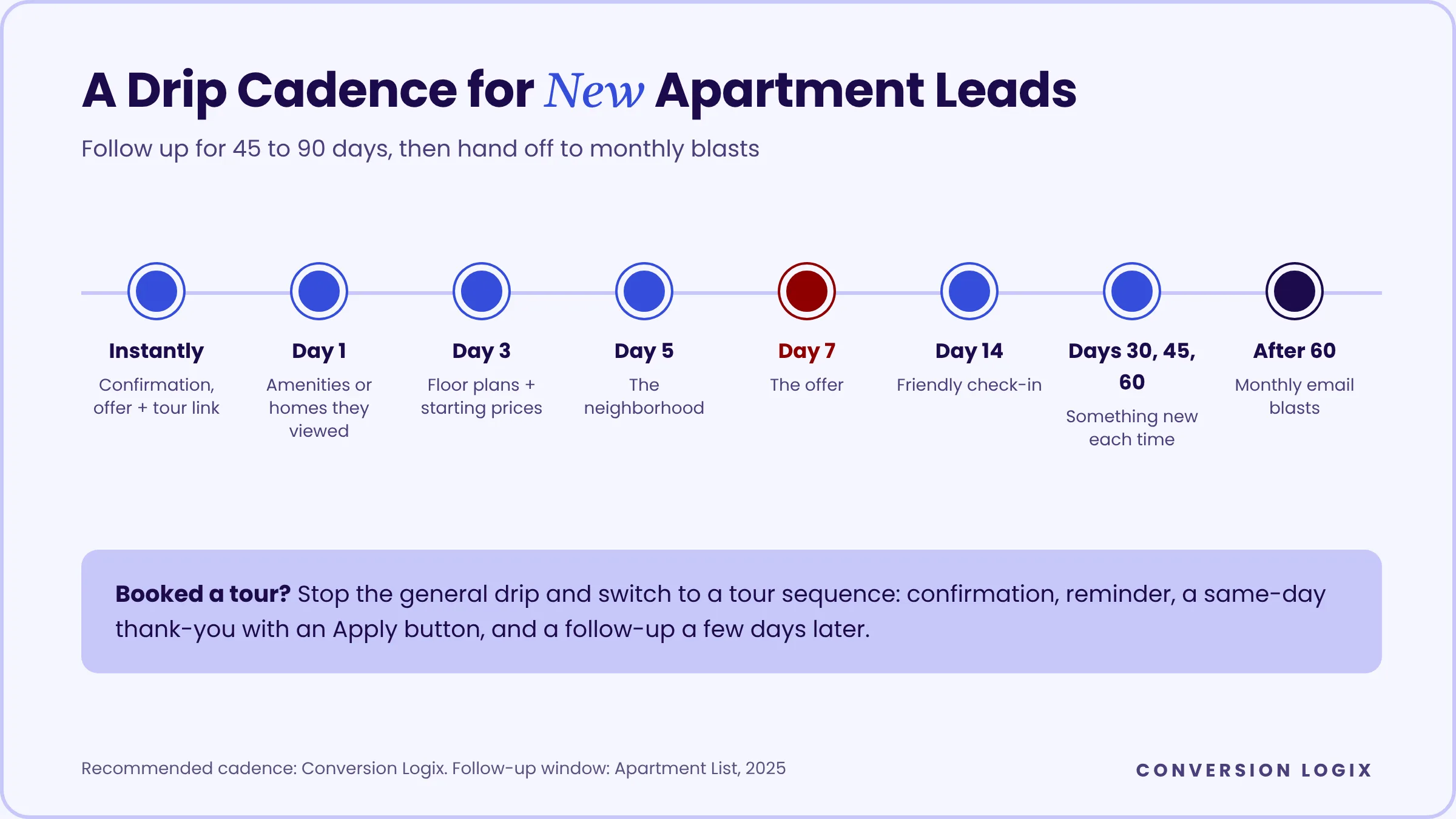
We recommend starting this cadence and adjusting depending on the engagement and opt-outs you see:
This 45-90 day follow-up window lines up with what Apartment List recommends for today’s slower-moving renters. One more rule: when a renter books a tour, stop the general drip and switch to a tour sequence. Send a confirmation, a reminder, a same-day thank-you with an Apply button, and a follow-up a few days later.
Blasts and Drips Work Best Together
Think of drips as the first few weeks of a relationship and blasts as everything after. Drips catch new leads while their interest is highest. Once the drip ends, blasts keep reaching the people who haven’t leased yet, which is most of your list when so many renters are searching with low urgency.
What CLX Data Reveals About Winter Email Performance
So when should those emails go out? This is where our data gets interesting.
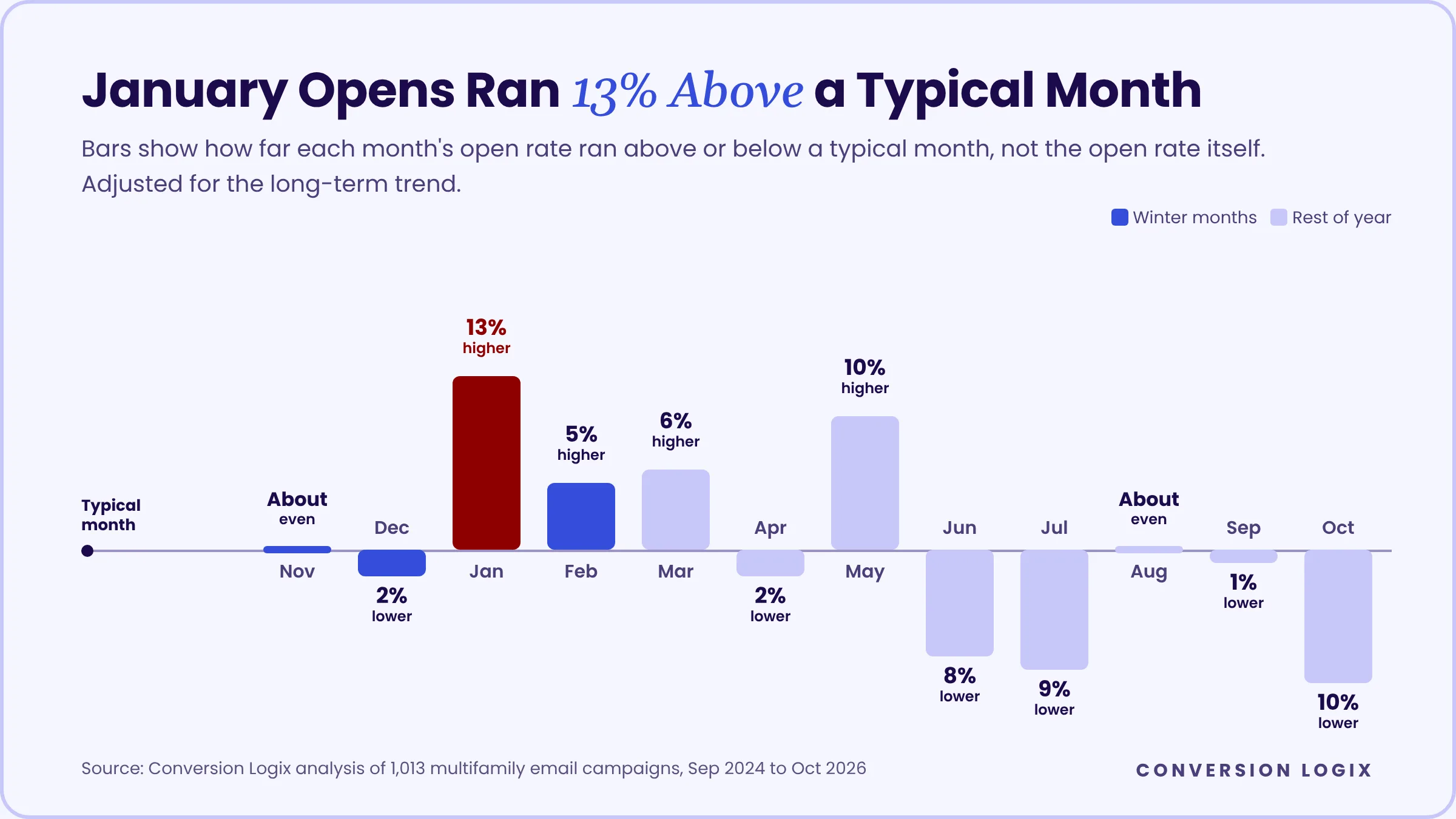
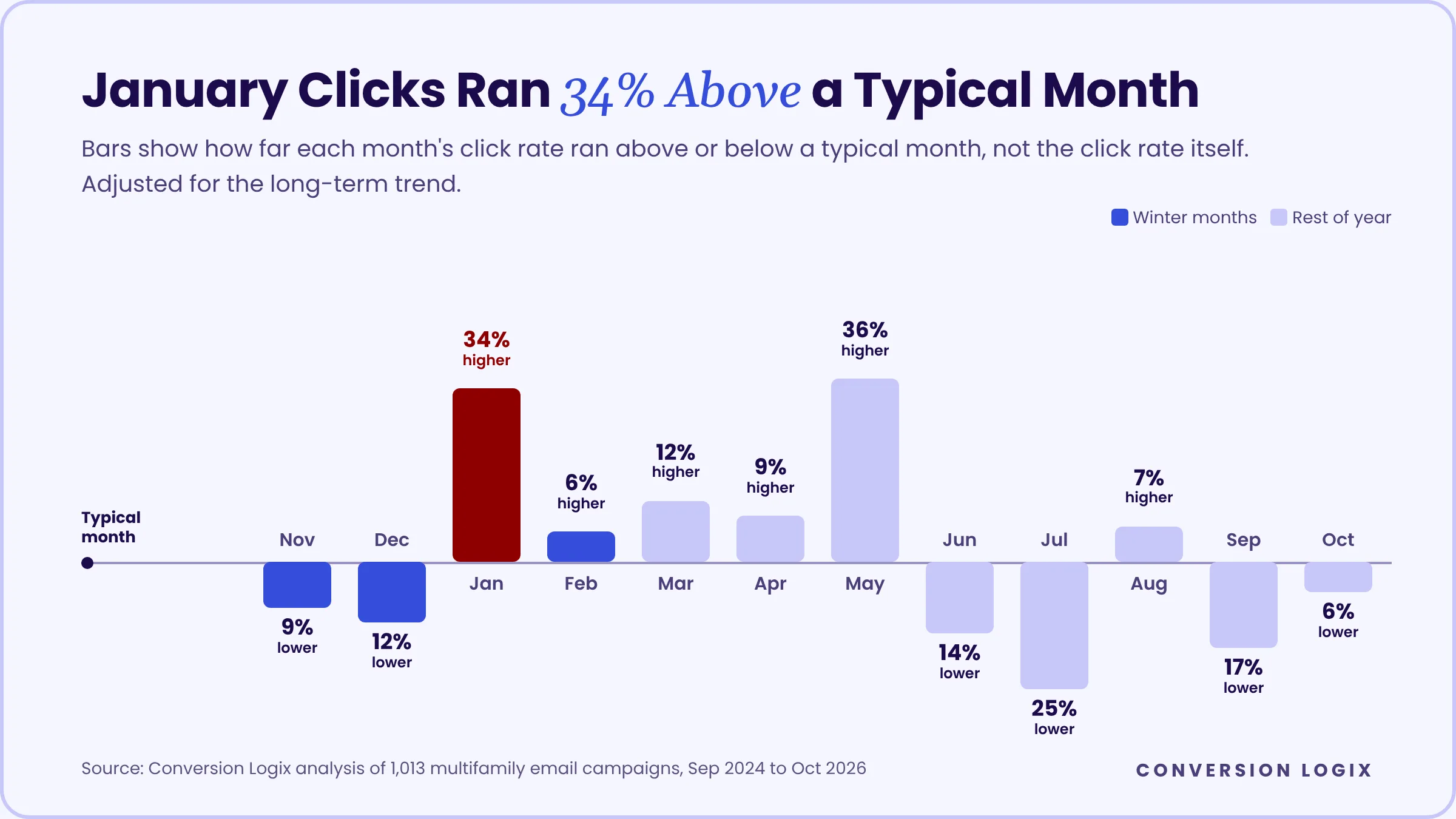
In the Conversion Logix analysis of 1,013 multifamily email campaigns from 2024 to 2026, winter opens held steady while clicks swung sharply. January was the standout on both: opens ran 13% above a typical month, and click rates ran 34% above. December was the opposite story, with opens close to normal but click rates 12% below.
Renters Keep Opening Emails in Winter
If you’ve been treating winter as a time to go quiet, the open data says otherwise. Winter emails were opened about 7% more often than emails sent the rest of the year. No winter month fell meaningfully below a typical month for opens. The weakest months for opens were October, July, and June, not December.
That’s the opposite of what general email benchmarks show. Across other industries, open rates tend to peak in November and bottom out in January, following holiday shopping. Apartment email follows renter behavior instead, and renters planning a move start paying closer attention once the holidays are over.
Clicks Are What Move
Opens tell you renters are still reading. Clicks tell you whether they’re ready to act, and that’s where we see the differences in how the send month can affect traffic. Opens stayed within about 10% of a typical month all year, apart from January. Click rates ranged from 25% below a typical month to 36% above.
Over the full year, winter click rates were about the same as the rest of the year. The weakest months for clicks were July (25% below a typical month), September (17% below), and June (14% below). Within winter, though, clicks dipped in November and December, then jumped in January to tie May as the best month of the year.
December Is a Click Problem, Not an Open Problem
Here’s how each winter month compared with a typical month, adjusted for the long-term trend:
Source: Conversion Logix analysis of 1,013 multifamily email campaigns, Sep 2024 to Oct 2026. Adjusted for the long-term trend.
December is the month to watch. Renters opened December emails at close to their usual rate, but far fewer clicked through. The share of openers who clicked was 15% below a typical month, the lowest of the entire year. Your December emails are being seen. They’re just competing with travel plans, gift lists, and year-end deadlines for the renter’s next step.
January is where both measures line up. More renters open, and more of those who open take action, which makes it the best window of the season for your strongest offer.
What This Means for Your Winter Plan
- Keep sending all winter. Renters are still opening, so going quiet gives up attention you’d otherwise get.
- Make December emails easy to act on. Lead with one clear offer and one obvious next step, since the challenge is the click, not the open.
- Save your strongest offer for late January, when renters are back from the holidays, and both opens and clicks peak.
About the data: the Conversion Logix analysis covers 1,013 multifamily email campaigns sent from September 2024 through October 2026, including 334 sent from November through February. Results vary widely from email to email. The top 10% drew more than twice the click rate of a typical send, and the bottom 10% drew less than half, so the same list can swing a lot depending on the audience and timing.
How to Increase Your Apartment Email Performance During the Slow Season
Timing sets the stage, but what you send still decides whether renters click. To get the best results this season: lead with a big, simple offer, give renters a specific reason to open, and skip the urgency words this winter. In our analysis, winter subject lines with urgency words drew 23% lower click rates.
When Should You Send Your Best Winter Offer?
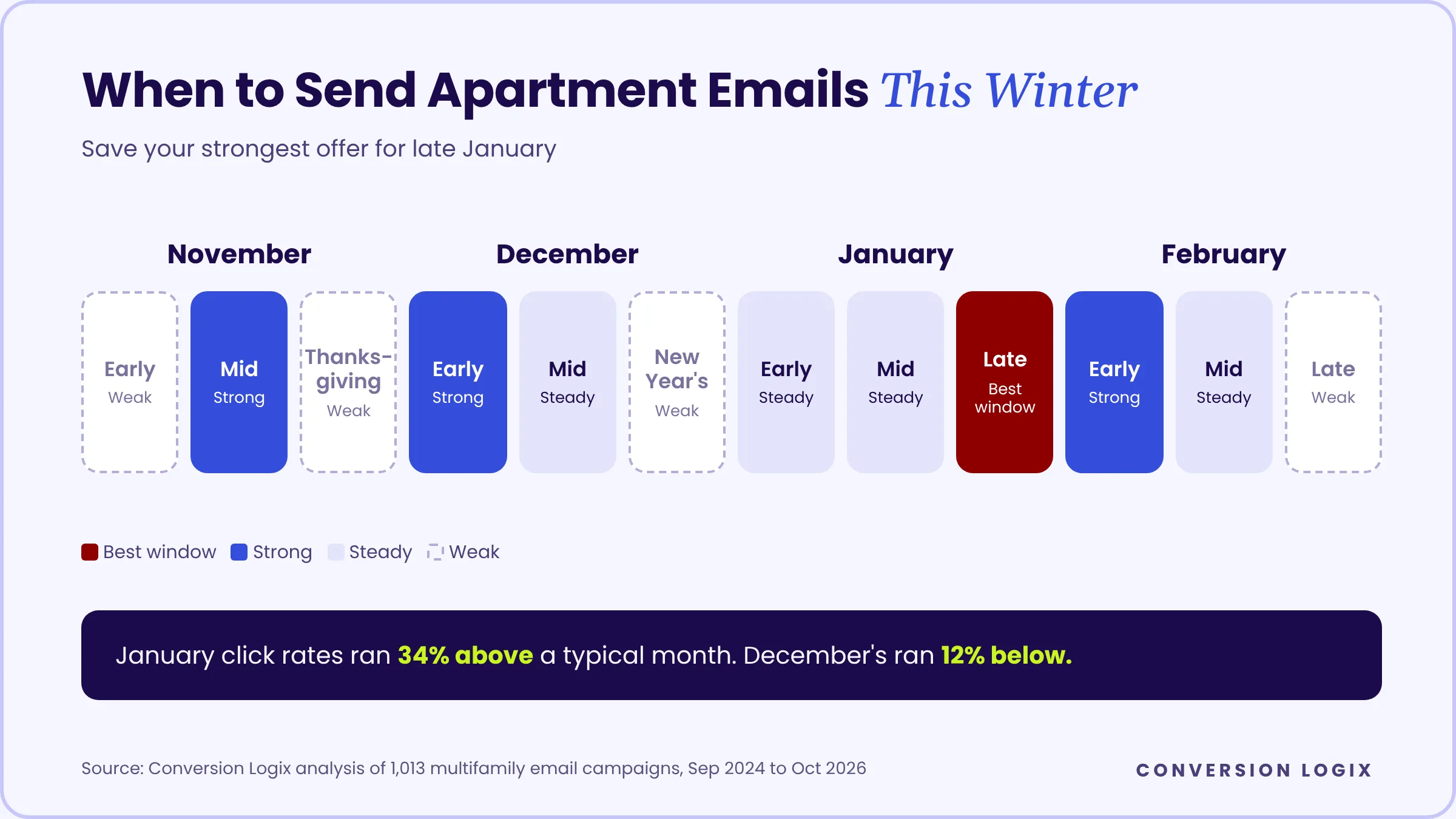
Not every week of the slow season is equal. Based on our data, the strongest windows are:
- Mid-November (roughly the 11th to the 20th)
- Early December
- Late January, the best window of the season
- Early February
The weakest stretches are early November, Thanksgiving week, the days around New Year’s Eve, and late February. One “Year-End Special” from a community in Rocklin, CA, went out on December 31 and drew about 60% fewer clicks than a typical December email.
How Often Should You Send Email Blasts to Your Lead List?
About once a month. Monthly senders had the highest click rates and the lowest opt-out rates of any sending rhythm, and sending more often didn’t push opt-outs up, so a steady rhythm is safe.
Two more things to keep in mind:
- Don’t go more than two months between sends. Opens fell 5% after a two- to four-month gap and 8% after four months or more.
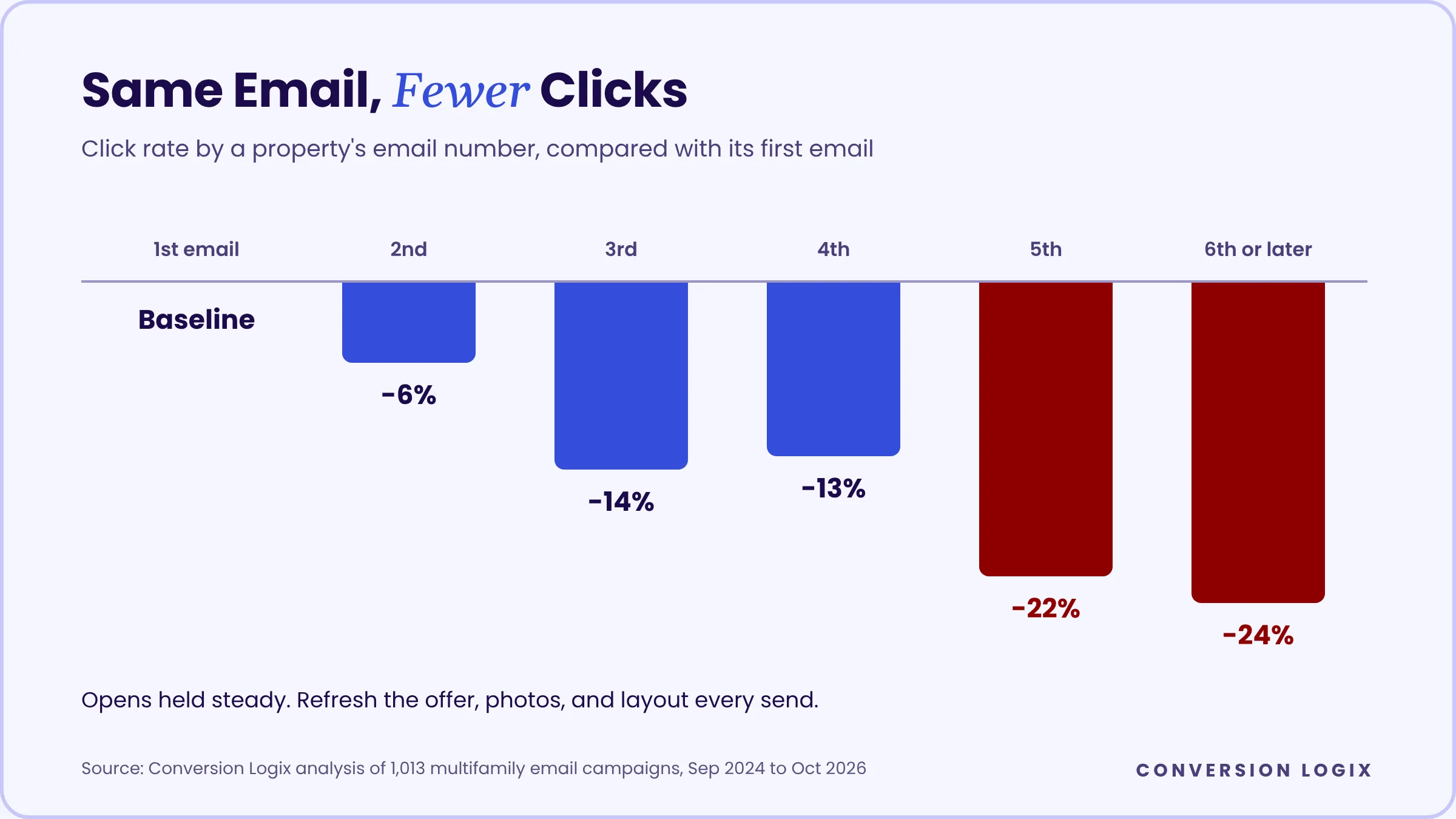
- Refresh the content every time. Clicks fell 22% by a property’s fifth email and 24% by its sixth, while opens held steady. Many properties reused the same template, offer, and photos, which likely explains it: renters were still opening, they’d just seen it before.
What Subject Lines Work Best for Apartment Emails in Winter?
Subject lines matter less than who’s on your list and when you send. Differences between properties and their lists explained far more of the variation in open rates than any subject-line choice. Still, a few choices made a measurable difference in winter:
- Ease off urgency. From November through February, subject lines with words like “now,” “today” or “limited” saw 23% lower click rates. The rest of the year, the same words went with 22% higher click rates. Winter renters are more likely to take their time, and using urgency wording in copy doesn’t seem to improve opens.
- Leave the property name out during the holidays. From mid-November to mid-January, subject lines with the property name had about 11% lower opens. The rest of the year, they had about 5.5% higher opens.
- Skip emojis, especially decorative ones. Subject lines with emojis went with about 6% lower opens. Sparkles, faces and leaves were the weakest. Holiday emojis that matched the message came closest to neutral.
- Give a specific reason to open. In our review of the best and worst winter emails, every low performer had a generic subject line, like “Find Your New Home Today!” The top emails named the offer or used a specific lifestyle hook.
A note on personalization: we used the renter’s first name in 97% of these campaigns, so this data can’t isolate its effect. It’s still a tactic we recommend testing in your own campaigns.
What Email Design Gets Apartment Prospects to Click?
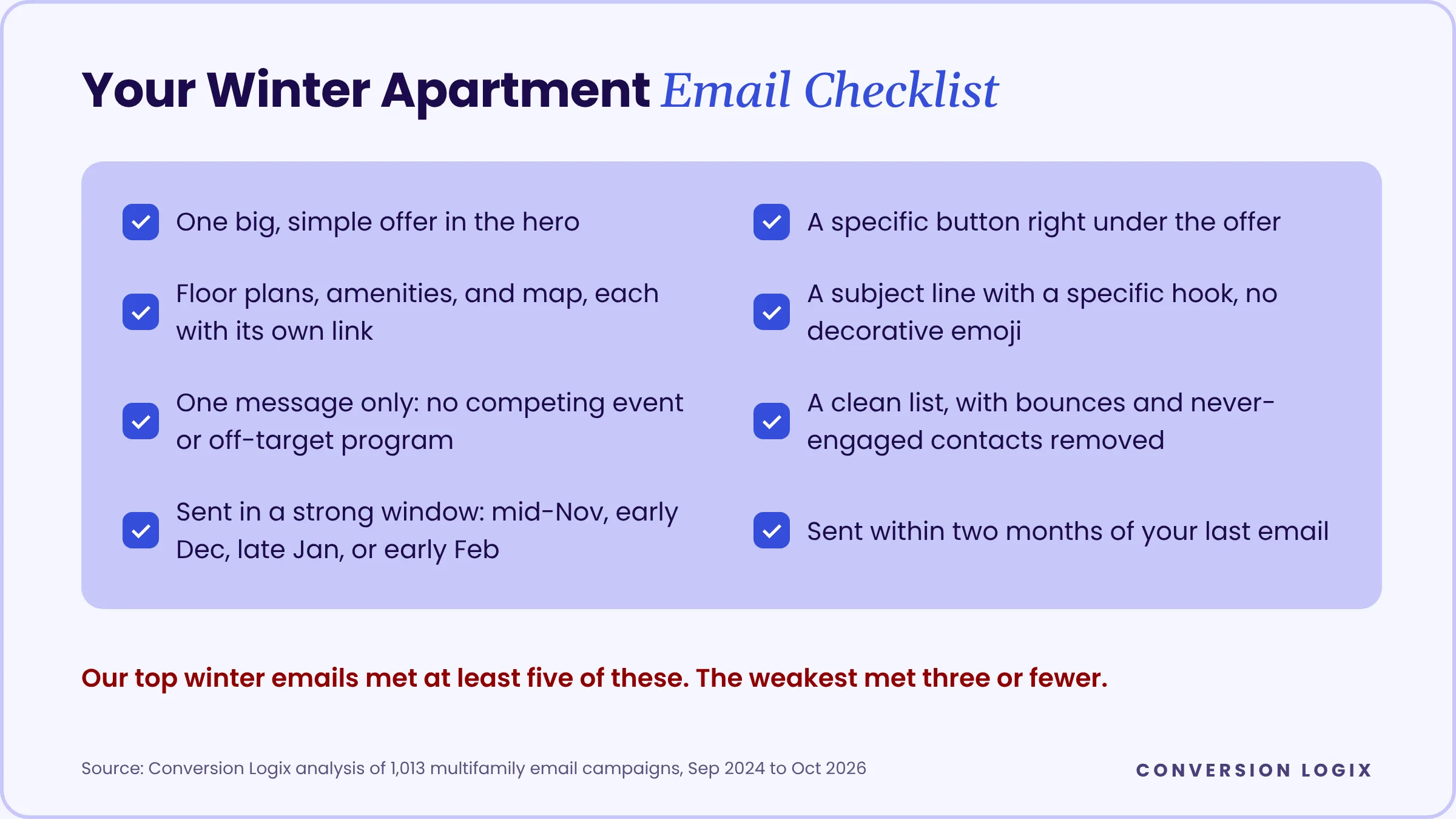
When we compared our six best winter emails with our seven weakest, the top emails drew about 10 times the click rate and twice the open rate. The clearest difference was the offer: the top emails offered a median of about seven weeks free or led with dollar amounts, while the weakest offered about two or tended to use complex and vague offer messages. But a big and clear offer wasn’t enough on its own. Some of the weakest emails offered six to eight weeks free and still underperformed, held back by competing hero messages, limited CTAs, and less relevant visuals.
Here’s what the most clicked emails had in common:
- The offer sits in the hero, with a button right under it. Claim Offer, Tour Today, or Schedule Your Tour.
- The hero carries one message. A community in North Hollywood, CA, put an open house banner above its rent offer, and another in Los Angeles sent prospects a resident referral program. Both diluted the hero message’s effectiveness and resulted in fewer clicks compared to emails that focused on one main message at the top of the email.
- Emails present information within a specific order. Emails featured images of the properties’ interiors and floor plan details, then amenities, then a map showing the location, each with its own link to increase follow-through to the site. The top emails offered five or more easy clicks, which suits winter renters who aren’t ready to commit but are happy to look around.
- Visuals and scannable content did most of the talking. Large photos (of the spaces renters care about most: units and standout amenities and living spaces), short lists, and GIFs beat long paragraphs.
A few examples from last winter show how much the offer, and how clearly it’s presented, can move results:
- Escondido, CA: A community offered up to two months free plus $500 on February 3. Its click rate ran about four times that of a typical February email.
- Seattle, WA: Two communities emailed in November with opposite results. One named a six-week offer right in the subject line and drew about three times the typical November click rate. The other offered even more, eight weeks free, but hid it behind a gimmicky subject line, and its click rate ran about 60% below typical.
- Reno, NV: A community offered free rent until January 1 in a December 12 email and drew about twice the typical December click rate, in the slowest month of the season for clicks.
- Miramar, FL: A community led with a simple “$2,000 off select apartments” offer on December 11, and its click rate ran nearly twice the December norm.
- Same property, five weeks apart: A community in Fairfield, CA, sent a January email with four weeks free and a specific subject line, and its click rate ran about twice the January norm. Its February email swapped in “reduced rents” and a generic subject line, and its click rate fell about 87%.
How to Measure Email Marketing’s Impact
Once you’ve improved what you send, you need a fair way to tell whether it’s working. Judge each email against a typical send from the same month, not just the whole year, then follow it through to opt-outs, website actions, and conversions. That month-to-month swing is bigger than most teams expect: in our analysis, January’s typical click rate ran about 70% above December’s.
Open rates
Opens within email blasts say more about how engaged your list is than how good your subject line was. Treat them as a rough signal of list health but still follow subject line copy best practices to get the highest rate you can.
Click-through rates
Clicks are a reliable measure of interest. Keep the ask in mind, too: an event invitation may draw fewer clicks than a link to floor plans. Tag every link with UTM parameters so you can follow that traffic in Google Analytics.
Opt-outs
Track opt-outs for every send. A sudden jump points to list fatigue or a message that missed, and a steady stream is a sign renters have decided where to live, and it’s time to clean your list.
Key events and engaged sessions
In GA4, look at how many sessions from your emails take a conversion action on your site, like calling, emailing, or scheduling a tour. This tells you whether email is driving actions, not just visits.
Conversion attribution
Email is rarely the only touchpoint. A renter might click your January offer, come back through a search ad a week later, and book a tour from there. Conversion Logix clients can see this in the Conversion Paths report in CLiQ’s Insight Reporting, which shows how many touchpoints and conversions are credited to email alongside your other campaigns. If email is regularly part of the path, it shows up in your top 15 conversion paths.
One more thing to consider: your list size. Big lead lists tended to see lower open rates, but sends to 5,000 or more contacts drew about 13 times as many total clicks per email as lists under 500. Judge large sends by total clicks and opt-outs, not by rate alone.
Apartment Marketing Strategies to Build Your Lead List This Winter
Email can only nurture the leads you have, so the last piece of a slow-season plan is keeping your list growing.
Advertising keeps new renters coming in when search slows. With fewer people searching Google for apartments in winter, channels like Display, Meta, Instagram, YouTube, and Connected TV reach renters in your area before they’re actively looking. That keeps awareness and site visits up, which builds the pipeline your emails nurture toward a lease.
Website apps turn those visits into leads. At an apartment community in Mesa, AZ, the website featured a Spotlight offer, a pop-up from The Conversion Cloud that highlights a special and asks visitors to share their contact information to claim it. In this case, the offer was a move-in bonus. The campaign produced 98 leads, 35 scheduled tours, and 26 leases, and 63 renters claimed the offer. Seventy percent of those leads converted on their very first website visit, and 35% had seen a Conversion Logix ad before they converted. Ads bring renters to your site, and website apps turn that visit into a lead your emails can nurture.
Keep Your Leasing Pipeline Moving All Winter
A slower leasing season doesn’t have to mean a weaker pipeline. The renters on your list are still interested. They’re just busy, distracted, and comparing a lot of offers, and email is how you stay with them until they’re ready.
The communities that come out of winter with stronger leasing momentum balance both sides of the equation: advertising and website lead capture to bring new prospects in, and well-timed blasts and automated follow-ups to keep those relationships moving toward a lease.
At Conversion Logix, we help apartment communities connect those pieces so they stay visible, keep prospects engaged, and keep leasing all year. Schedule a call to see how our digital advertising, lead generation, and email marketing solutions can support your winter leasing goals.