


Your Google Ads campaigns are generating leads. Cost per lead looks reasonable. Search volume is there. On paper, the campaign appears to be doing its job.
Then you look at the leasing results.
Too many of those leads never schedule a tour, submit an application, or sign a lease.
For apartment marketers, this is becoming one of the more important questions to ask of a paid search strategy: Are your campaigns optimized to generate high-intent leads?
Google Ads is increasingly built to make decisions using signals about the people most likely to take meaningful action. That makes the first-party data your properties already collect increasingly valuable. Instead of relying solely on what someone searches, advertisers can give Google more information about which prospects ultimately matter.
And the deeper that signal gets, the more useful it can become.
Signals now decide who Google reaches and what it bids
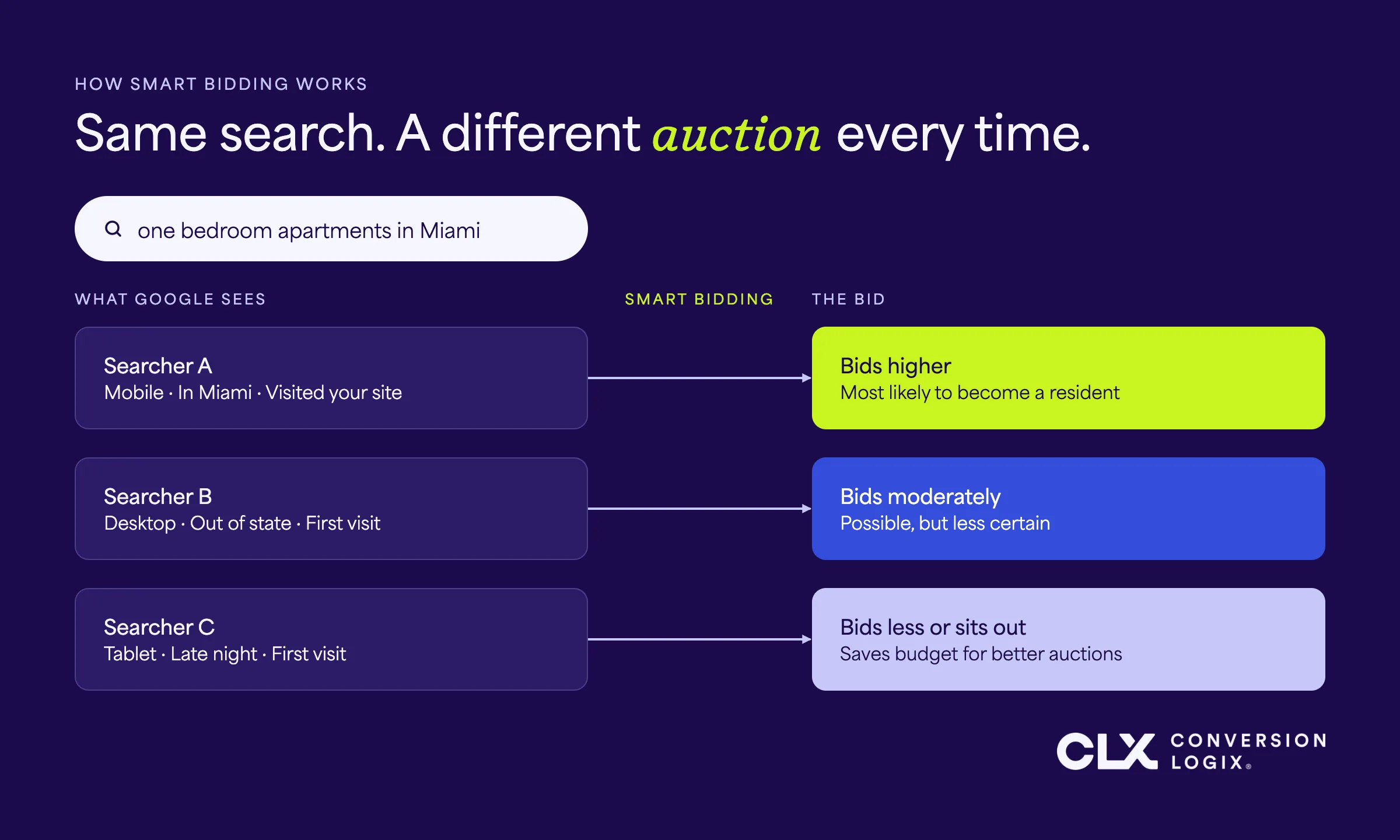
Think about a search like “one-bedroom apartments in Miami.”
Plenty of people can type those words into Google. Some may be ready to move next month. Others could be casually researching neighborhoods, comparing prices for a future move, or clicking through several properties without any intention of touring.
Keywords tell Google what someone is searching for. Signals tell Google which of those searchers are more likely to take action. Together, they help Google decide which searches to bid on, how much to bid, and where to expand targeting.
The strength of these signals really matters as more of Google’s advertising becomes automated. Google is steadily loosening its hold on exact keyword matching. Over the next year or so, the keyword you bid on will matter less, and the signals you give Google will matter more.
This is especially true for Performance Max, Demand Gen, and Search campaigns running AI Max. These new campaigns and features give Google more freedom to find new prospects, but they also give more room to find the wrong ones. We expect conversion signals and first-party data to be among the best ways to keep that in check.
One of the primary ways Google lets advertisers influence targeting is through audience signals.
What are audience signals?
Unlike targeting, which acts like a fence to show Google how you want to limit who sees your ads. Audience signals are more like the guidance you provide Google to teach it about the type of searcher you want it to reach. It tells Google at the start of a campaign, the first types of people it should try to reach within your targeting parameters.
Audience signals work a little differently depending on the campaign. In Performance Max, they steer Google’s AI toward the right prospects from day one. In Demand Gen, they can build Lookalike Segments from your first-party data.
For apartment campaigns, the most useful signals are:
- First-party data: examples include renters who submitted a lead form, viewed your floor plans, or signed a lease
- Custom segments: the searches you’d expect from renters looking for a place like yours
- In-market segments: people Google already sees as actively looking for an apartment
When you design audience signals, you have the ability to use a unique combination of these audience segments to design the training information you provide to Google. If you do this well, you can get your campaigns to perform faster and reduce wasted spend bidding on prospects who aren’t likely to rent at your property.
Training Google how to set up targeting at the start of a campaign is only one of the ways the signal data you provide can help Google optimize your campaigns.
The rest happens in the auction.
What are conversion signals?
Every search triggers its own live auction, and Google has a split second to decide what each one is worth to you. Conversion signals guide that decision. They tell Google which actions matter to your property, like a submitted lead, a booked tour, or a completed application, and which clicks led to them.
Over time, Google learns the patterns behind those conversions. When a new search looks like the ones that turned into tours, it bids more aggressively. When it doesn’t, it pulls back and saves budget for auctions more likely to convert. This is known as Smart Bidding.
The catch? Google can only optimize toward what you tell it counts. If a form fill is the only conversion it sees, it will get very good at finding form fills, whether or not those prospects ever lease.
A lead is a good signal. A lease is better.
When Google’s AI controls so much of your campaign, signal quality becomes one of the few things you can still control. Google won’t tell you which of your signals is the biggest driver of success, so the only way to know is trial and error at scale.
Here are some of the takeaways we’ve learned from testing them across thousands of apartment campaigns.
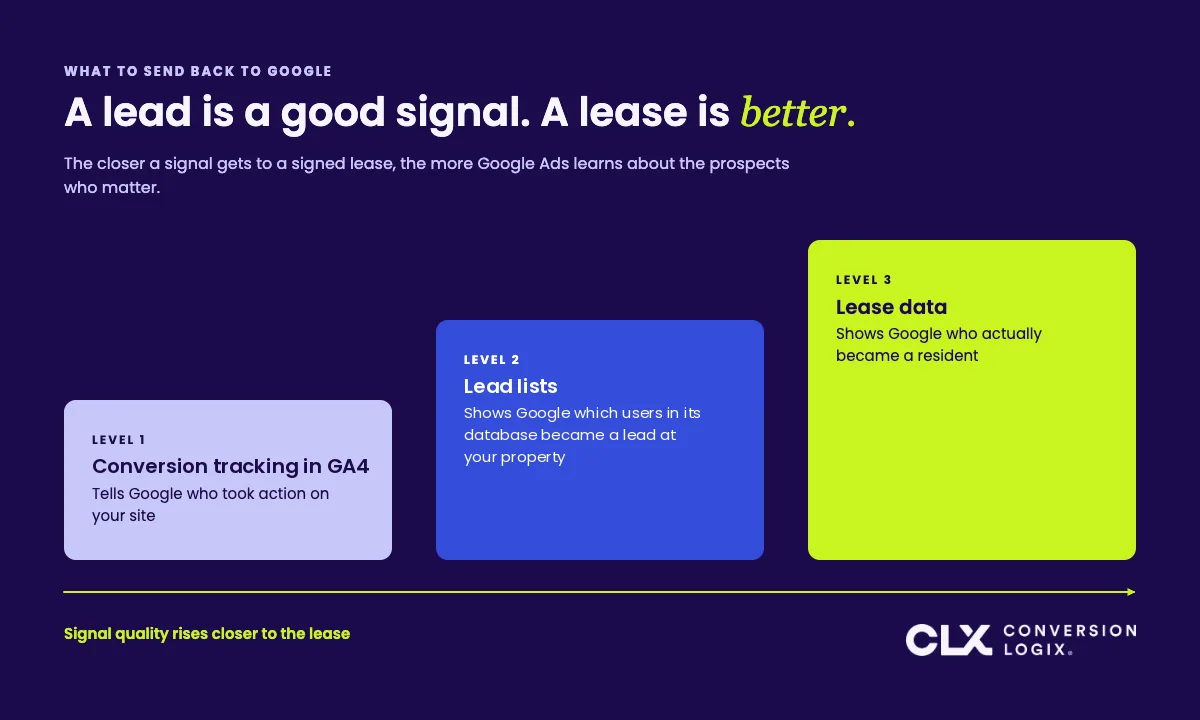
The signal ladder: website conversions, lead lists, leases
Conversion tracking through Google Analytics 4 is an important starting point.
Every time someone completes a meaningful action on your website, Google gets another example of a prospect worth finding. But this kind of signal only works if your tracking is accurate. One of the first things we check when a campaign underperforms is whether its tracking is set up correctly, isn’t blocked by other scripts on the site, and counts each conversion once. If any of those are off, Google is learning from bad data.
Lead lists take signal quality one step further.
While GA4 conversion tracking is a good place to begin, the next-best data you can provide to Google is a list of leads. With lead lists, Google can match the prospective renters on your list with users within its database to better understand your audience, and can use these insights to target similar prospects. The larger the list, the better the results. One of the ways we grow the size of these lists is with The Conversion Cloud®. We deploy lead applications on our clients’ sites, and when their lead lists are large enough, we send this data back to Google to improve targeting.
Lists of renters who leased at your property are the best input you can provide Google.
A lead tells Google to “Find more people who behave like the prospects who contacted us.”A lease tells it, “Find more people whose online behavior matches prospects who ultimately became residents.” There are two ways to tell Google about leases, and they do different jobs:
- A resident list shows Google who became a customer. You upload residents’ contact information, and Google uses it to understand and find similar people.
- A lease conversion shows Google which ad interaction led to a signed lease. That lets Smart Bidding optimize toward leases instead of form fills.
Both are valuable, but uploading a resident list doesn’t change what Google is bidding toward. With lease conversion data, if you set “lease signed” as the primary conversion goal, Smart Bidding can bid more aggressively on searches that look like ones that led to leases.
While lease conversions are the ideal signal to provide Google, implementing them comes with a few challenges:
- Cycle length: The time from click to lease can be long. Google only credits a conversion to a click within its conversion window, which tops out at 90 days.
- Data connection: The property’s CRM or PMS has to send leases back with an identifier that Google can match.
- Volume: Smart Bidding needs a steady flow of conversions to learn. Most single properties don’t sign enough leases a month to support bidding toward leases alone.
The challenge: many apartment communities do not have enough leases to optimize from
While Google has changed the threshold for the size of customer data you can provide from 1,000 to 100, meeting the minimum isn’t the same as giving Google a strong signal.
A 90-unit community may have a highly valuable list of residents or lease conversions, but the audience can still be relatively small for an advertising algorithm to learn from. A lead list might contain substantially more data, but it includes people who never leased. This is one of the challenges advertisers operating in the multifamily industry face when deciding what first-party signals to use in ad campaigns.
There are two ways around it.
- First, go back further: a 24-month lease history can push a smaller community past 100 residents.
- Second, think in markets, not just properties. One build-to-rent operator we work with is sending us every lease signed across its Myrtle Beach portfolio, which turns several small lists into one large one.
Another roadblock to be mindful of is the fact that Google will need to be able to match lease conversions to its own database of contacts to be able to leverage the conversions for optimization. A 1,000-person list may not all result in matches in the platform, which can increase the starting threshold you need to leverage the enhanced conversions feature.
Until a lease list (or lease conversion data set) is large enough to support the campaign, GA4 conversion events and lead data may be a better source for training your ad account.
Is your advertising partner closing the feedback loop?
Paid Search used to be easier to evaluate from the outside. You could look at keywords, bids, ad copy, landing pages, and conversions, and get a fairly good idea of how a campaign was being managed.
That’s changing. As Google Ads becomes more automated, more of the important work happens behind the scenes. So the question isn’t just how your campaigns are set up. It’s what they’re teaching the algorithm.
As your campaigns run, your advertising partner should keep feeding Google new information about who visits your site, who becomes a lead, and who signs a lease.
If your Google Ads bring in leads that never lease, more leads may not fix the problem. Giving the algorithm better information about the people who do lease is often a smarter place to start.
That starts with a simple conversation.
Ask your advertising partner one question: What are you teaching the algorithm?
If the answer isn’t clear, let’s talk.
Want more insights like these? Subscribe to the CLX newsletter.
Subscribe to the CLX newsletter to find out what’s changing in multifamily digital marketing and what we’re learning from our campaigns.
