



Today’s property marketers aren’t just optimizing for Google rankings anymore. They’re optimizing for AI-powered search experiences that answer questions, recommend properties, and summarize content before a prospect ever clicks a website.
Google’s AI Mode has surpassed 1 billion monthly users just one year after launch (Google). At the same time, EMARKETER forecasts that 31.3% of the U.S. population will use generative AI search in 2026 (EMARKETER).
For multifamily and senior living marketers, that shift raises an important question: Is SEO still relevant?
The short answer is yes…but it’s no longer the whole picture.
As AI becomes another way renters discover communities, marketers are hearing new acronyms like AEO (Answer Engine Optimization) and GEO (Generative Engine Optimization). In this blog post, we’ll break down the differences between SEO, GEO, and AEO and what these shifts mean for multifamily, student housing, and senior living marketers.
SEO: Helping Search Engines Find You
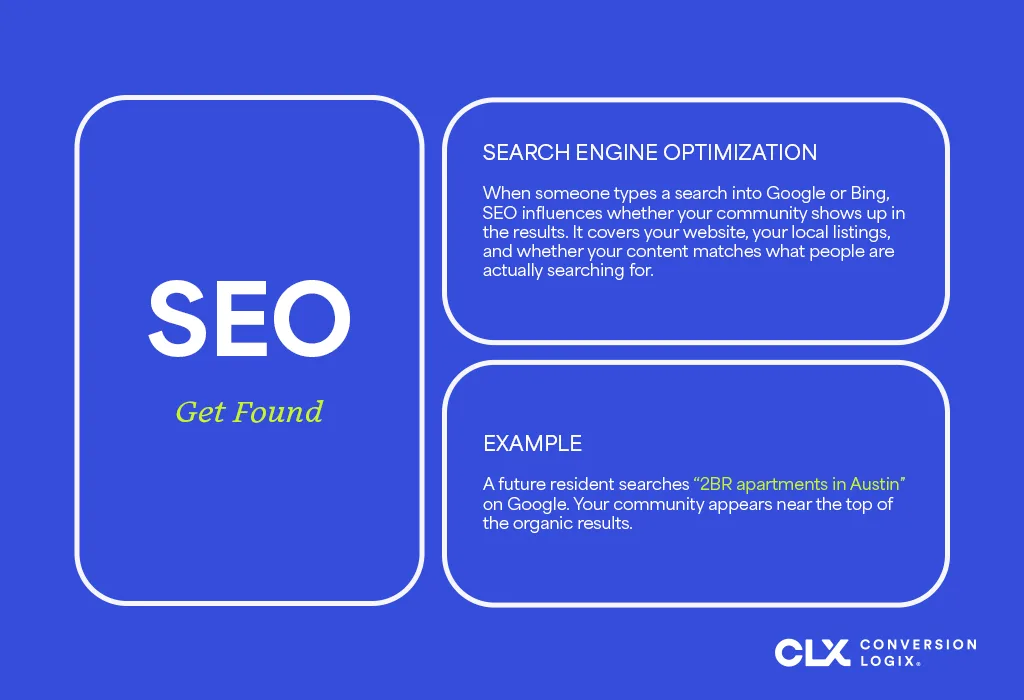
Search Engine Optimization (SEO) is still the foundation of online visibility.
Its purpose is to help search engines understand your website so your community appears when renters search for apartments, neighborhoods, amenities, or leasing information.
With SEO, the goal is to help search engines understand your website so it appears prominently in organic search results when someone is looking for apartments, neighborhoods, amenities, or leasing information.
For property marketers, SEO includes tactics like:
- Optimizing for local and neighborhood keywords
- Creating high-quality blog content around prospect questions
- Improving website speed and mobile experience
- Building authority through backlinks
- Keeping your Google Business Profiles accurate
- Publishing fresh, relevant content
For years, success was measured by rankings within search engine results, clicks on listings, and organic traffic.
Those metrics still matter.
In fact, Google has made it clear that its new AI Search experiences continue to rely on the same quality signals that have powered Search for years.
The difference is that traditional organic listings are now sharing space with AI-generated answers.
AEO: Helping Search Engines Answer Questions
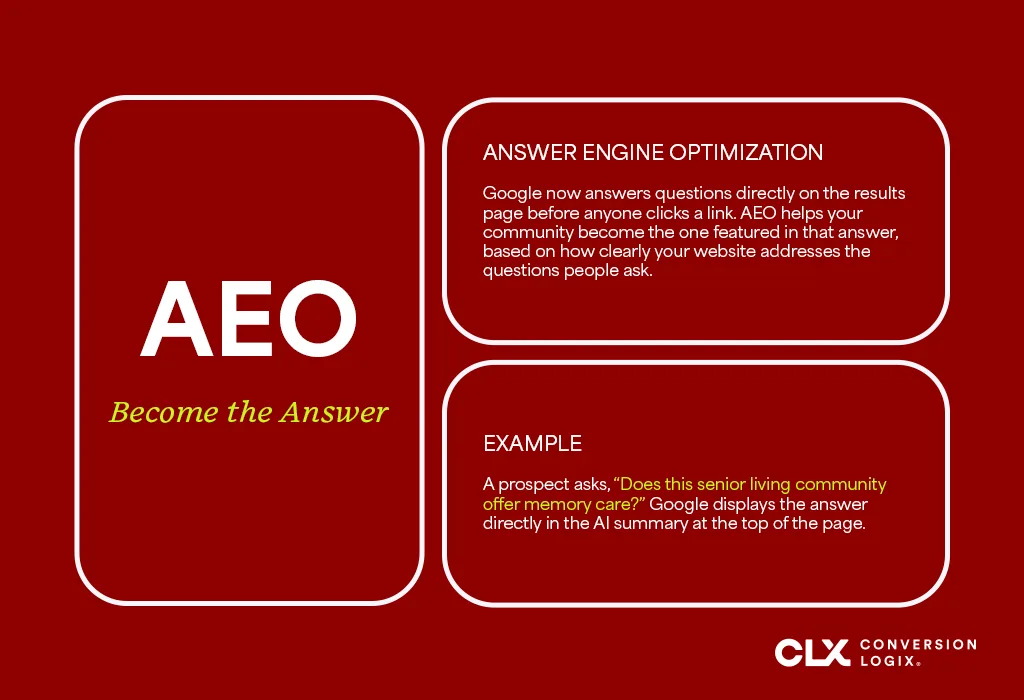
Answer Engine Optimization (AEO) focuses on making your content easy for search engines to use when answering questions.
The chat-like nature of LLMs has changed the way renters interact with search engines. Before the popularity of AI mode, searchers were most likely to ask short keyword queries, such as “apartments near me”. Many searchers still search like this today, but we’re now seeing a shift toward searchers using search engines to answer specific questions.
Renters are increasingly asking LLMs questions like:
- Which apartments in Denver have EV charging?
- Which student apartments near UW offer individual leases?
- Is this senior housing community walkable?
Rather than returning ten blue links, Google may generate an AI Overview or highlight a direct answer. To improve your chances of appearing in those responses, focus on making information easy to understand by:
- Adding FAQs on your site that answer common leasing questions
- Clearly explaining amenities, pet policies, parking, and lease terms
- Asking residents to leave descriptive reviews on your Google Business Profile
- Using descriptive page headings
- Making important property information readable as text on the page instead of solely embedding it in graphics
With AEO, the goal isn’t simply to earn a click. It’s to become one of the trusted sources behind the answer.
GEO: Helping AI Models Recognize and Reference Your Brand
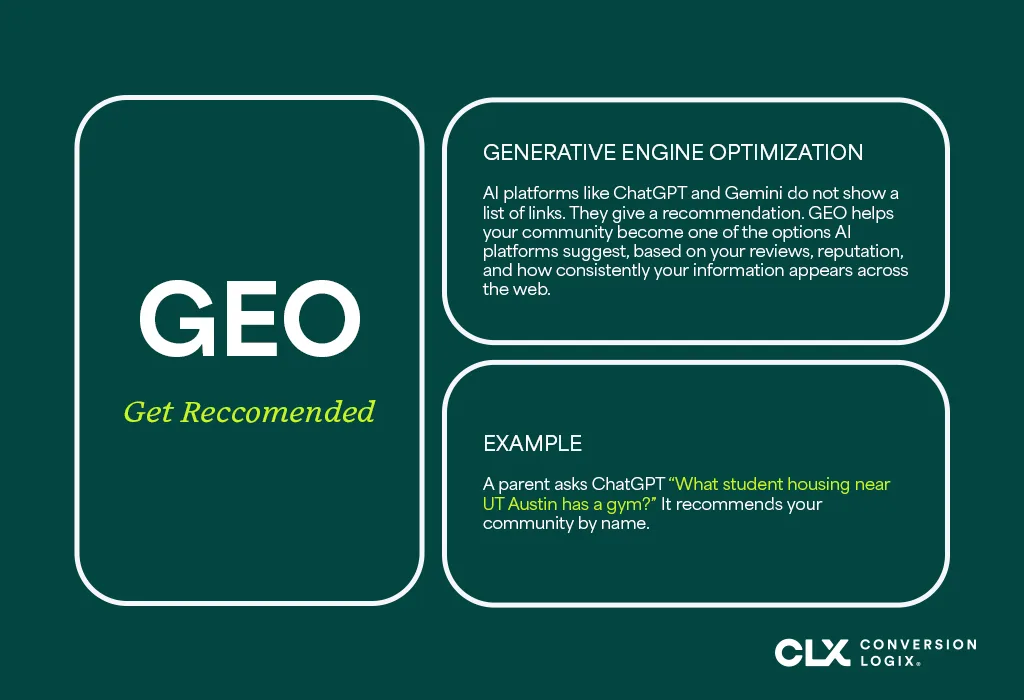
The goal of GEO is to help AI assistants like ChatGPT, Gemini, Claude, and Perplexity understand, trust, and cite your content when generating responses.
Imagine a renter asks ChatGPT:
“What should I look for when choosing an apartment community?”
Or a family member asks:
“What are the best assisted living options near San Diego?’
To answer that question, AI draws on the content it was trained on and, increasingly, real-time web results. It then weighs how consistent and credible the information is before deciding what to include in its response.
For multifamily and senior communities, those sources often include:
- Your website
- Google Business Profile
- Listing sites and directories
- Online reviews
- Local citations
- Social profiles
- News articles and local organizations
The more accurate and consistent those signals are, the more confidence AI has in referencing your community.
What This Means for Property Marketers
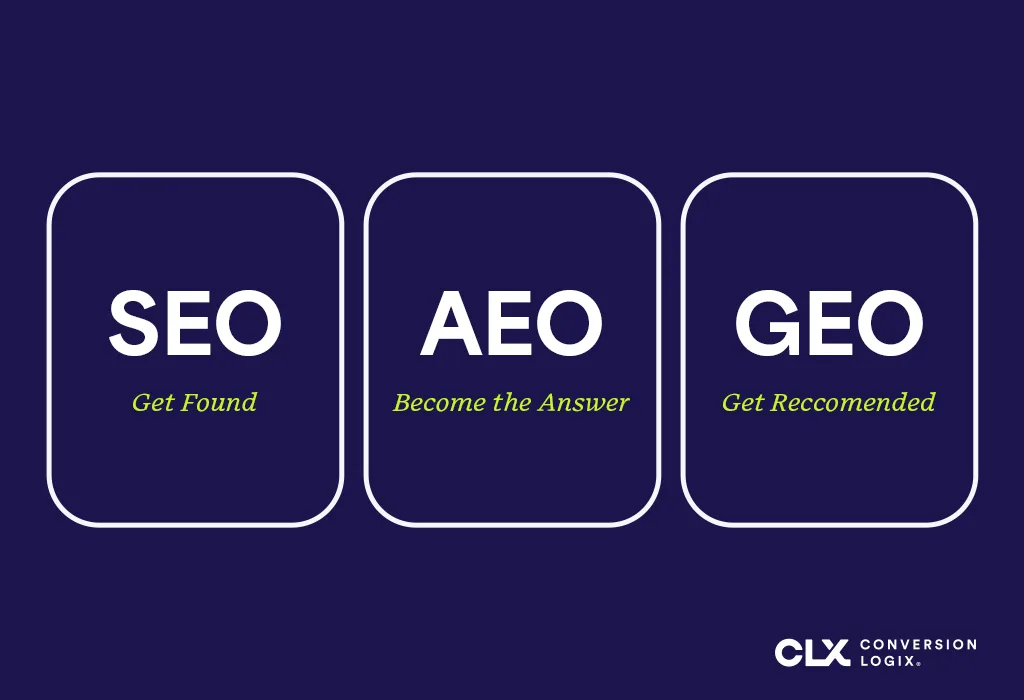
SEO, AEO, and GEO aren’t competing strategies. They’re complementary, and in many cases, these strategies work together to build your visibility across search engines and LLMs.
- SEO ensures your website can be discovered.
- AEO ensures your content clearly answers questions.
- GEO helps AI recognize your organization as a trustworthy authority worth referencing.
However, even with this overlap, mastering each of these strategies individually takes time, effort, and resources, and deciding where to put your focus can be tricky.
AI results are harder to track than organic search session results, making it tough for marketers using out-of-the-box reporting tools like Google Analytics and Google Search Console to make data-driven decisions about where to allocate their efforts.
According to EMARKETER, AI platforms send under 1% of referral traffic to even the most frequently cited sites, but visitors who do click convert at 4–5x the rate of traditional search. This means AI responses will likely generate fewer clicks to your site, but have the potential to deliver higher-intent leads.
To assess whether you are succeeding in this new landscape, marketers should measure mentions in AI results (you can do this today with new reporting software that tracks visibility in LLMs) and assess traffic quality (how engaged visitors from LLMs are), in addition to sessions, which is a shift from the traffic-heavy focus of traditional SEO.
What Property Marketers Can Do Today
Many of the activities you’re already doing support SEO, AEO, and GEO.
Here are a few areas worth prioritizing.
Keep your property information consistent.
Make sure your website, Google Business Profile, listing sites, and social channels all reflect the same information, including amenities, office hours, contact information, and specials.
Invest in your Google Business Profile.
Photos, reviews, and regular updates don’t just help traditional search. They also provide strong signals for AI-powered search experiences.
Answer your prospects’ most common questions.
If your leasing team hears the same questions every day, your website should answer them clearly. Think about parking, pet policies, application requirements, lease terms, utilities, tour options, or neighborhood attractions.
Keep content current.
An outdated concession, inaccurate leasing office hours, or an incorrect amenity doesn’t just frustrate prospects. It also makes it harder for search engines and AI systems to trust your information.
Build your reputation.
Positive reviews, local partnerships, and consistent engagement help establish credibility across both traditional search and AI platforms.
The Future of Search Is Broader Than Search Engines
Traditional search remains incredibly important, but AI-powered experiences are changing how renters discover communities and how recommendations are made.
For property marketers, the objective hasn’t changed.
Create accurate information. Answer real questions. Build trust.
Whether a prospect finds your community through Google Search, an AI Overview, or a conversation with ChatGPT, that’s ultimately what drives visibility.
Stay Ahead of the Future of Multifamily Marketing
AI search is changing quickly, but staying informed doesn’t have to be another full-time job.
Subscribe to the Conversion Logix newsletter for practical insights on multifamily, senior living, and student housing marketing, AI search, advertising trends, and strategies you can apply across your portfolio.
