


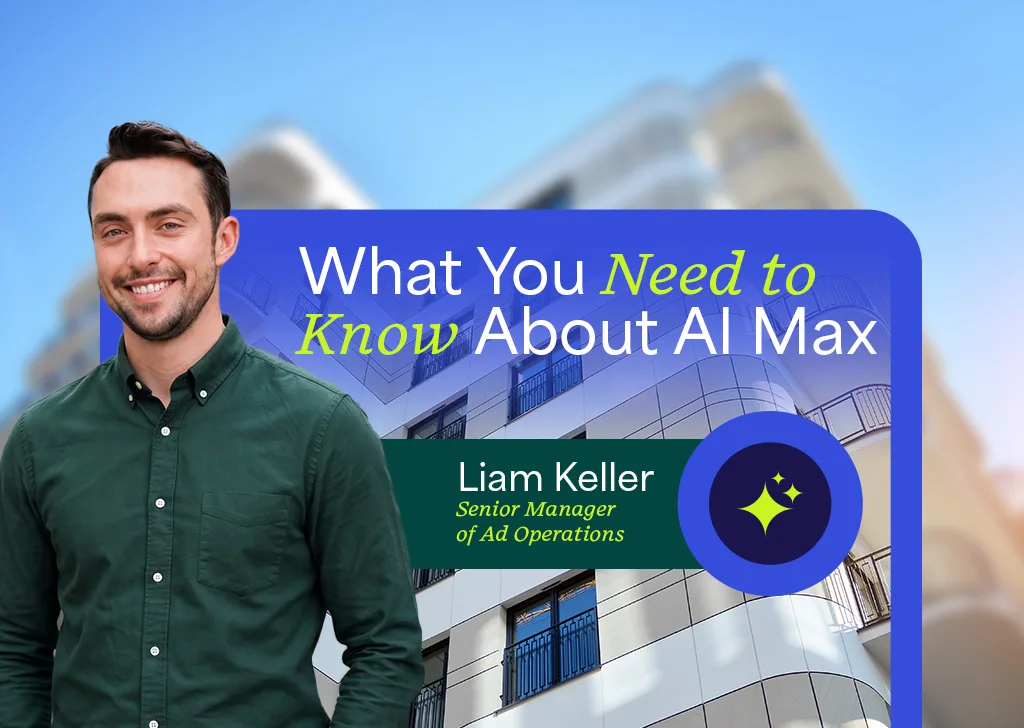
Google officially moved AI Max out of beta in April 2026. Starting in September 2026, campaigns running Automatically Created Assets and campaign-level broad match will automatically upgrade to AI Max. Dynamic Search Ads will follow in February 2027.
We sat down with CLX’s Senior Manager of Ad Operations, Liam Keller, to give apartment marketers an honest review of this new ad feature.
What is AI Max?
AI Max is not a new campaign type. It’s a toggleable enhancement layered on top of Google Search Ads. Think of it as Google expanding what your search campaigns can do.
The core capabilities:
- Keywordless matching: AI Max serves ads on queries beyond your existing keyword lists, using Google’s understanding of search intent to find demand you may not be targeting today.
- Dynamic asset generation: Headlines, descriptions, and calls-to-action are generated based on your website content and the user’s search intent.
- Final URL expansion: Google selects the most relevant landing page for each query rather than sending everyone to the same destination.
- Locations of interest: Targeting expands based on geographic intent, capturing renters searching for apartments near employers, universities, and neighborhoods, even if those terms aren’t in your keyword set.
Google reports that advertisers using AI Max with the full feature suite (search term matching, text customization, and final URL expansion) see an average of 7% more conversions at a similar CPA/ROAS compared to using search term matching alone.
Those are real results. But context matters, and multifamily isn’t a typical advertiser category.
Why Apartment Marketing Is a Special Case
Most of Google’s AI Max benchmarks come from industries where volume is the primary goal. Apartment marketing is different. A property with 300 units doesn’t need thousands of leads at varying stages of intent. It needs 300 qualified renters who match the community’s price point, pet policy, move-in timeline, and availability.
That distinction changes how you should think about AI Max.
The query expansion capability is genuinely useful for uncovering renter searches that traditional keyword strategies miss: apartments near major employers, pet-friendly communities, units with EV charging, neighborhood-specific searches, and relocation-focused queries. But AI Max doesn’t just add those queries on top of your existing targeting. It competes for the same budget. Every dollar spent on a broader, research-phase search is a dollar not spent on the high-intent, lower-funnel queries.
For campaigns that are budget-limited, which can happen even with significant spend in competitive metro markets, that tradeoff means AI Max can quietly shift your mix toward upper-funnel traffic at the expense of the searches most likely to drive tours and applications.
So, which properties should consider using AI Max?
“New communities in large cities with large budgets, particularly in markets with high relocation activity, are better candidates for AI Max”, says Liam. “Renters who are moving from out of state or across the country tend to search differently. They ask more questions and research the geographic area more than renters moving within their local area. That’s exactly the kind of demand AI Max is designed to capture. For communities that don’t fit that profile, the risk of diluting high-intent spend is greater.”
What CLX Is Watching For
“AI Max feels similar to the early rollout of Performance Max,” Liam Keller says. “The opportunity is significant, but reporting, controls, and transparency will likely continue evolving over the coming quarters. We’re watching it closely before recommending it at scale.”
On the traffic quality problem specifically: “As Google expands beyond existing keyword lists, negative keyword governance becomes more important,” Keller says. “Maintaining traffic quality doesn’t happen automatically; it requires active management.”
We’re also closely watching the Fair Housing dimension. AI Max generates ad copy dynamically based on website content and search intent. In multifamily, every AI-generated headline is still subject to Fair Housing compliance review, which is why asset generation requires greater oversight in this industry.
What Needs to Be in Place Before You Turn on AI Max
Search campaigns require strong data signals in order to successfully target renters looking for a property like yours. This is even more true for properties that want to test AI Max. If you turn it on in an account with weak conversion tracking and first-party data, and you’re handing Google’s AI an incomplete picture to work from, which can drain your budget on traffic that doesn’t convert.
Before AI Max makes sense for a multifamily account, CLX believes the following needs to be in place:
- Conversion tracking tied to real leasing outcomes. Connecting tour, application, and lease conversions can help AI Max optimize for higher-intent leads. If you provide Google with shallow conversion signals, you’ll end up with subpar optimizations.
- A negative keyword framework built for AI Max’s expanded reach. The standard negative keyword list isn’t designed for keywordless matching. Home purchase terms, job search terms, student housing crossover, and competitor research queries all need explicit exclusions.
- Search term monitoring. AI Max generates new search term reports that didn’t exist before. These need to be reviewed regularly.
- Asset review for brand accuracy and Fair Housing compliance. Dynamically generated headlines need a review process.
- First-party data. Customer Match adoption, CRM integration, and offline conversion imports all improve the quality of signals Google’s AI is working from. The communities that get the most out of AI Max will be the ones that have invested in this foundation.
Where AI Search Ads Are Headed
AI Max is directionally where Paid Search advertising is going.
At CLX, we’re actively piloting AI Max, monitoring performance across community types, and building the negative keyword frameworks, asset review processes, and attribution infrastructure needed to ensure a responsible rollout.
While we aren’t recommending a broad rollout just yet, we are focused on laying the right groundwork so our clients are set up to achieve strong, reliable results as the product evolves.
Stay ahead of Google’s AI ad changes.
Subscribe to the Conversion Logix newsletter for ongoing updates on AI search, paid media strategy, and what’s actually moving the needle for multifamily marketers.

Already a CLX client?
If you have questions about how these changes affect your account, reach out to your account manager directly.