


What if you could put your community in front of renters at the exact moment they ask an AI chatbot where to live? And what if you were one of the first marketers in the industry to advertise there?
That’s exactly what we just did. In June, we became one of the first agencies to run ChatGPT ad campaigns for multifamily and senior living, testing five communities across the U.S. over 30 days.
If you’ve been watching this space, you know why we moved fast. Over 900 million people use ChatGPT every week, and it’s quickly becoming the next place search traffic moves. Renters are already using it to research where to live, and families are using it to compare senior living options. Until recently, though, the ads were only open to very large national brands.
We’ve been tracking the platform since the pilot launched in February, and over the past few months, OpenAI has built out what advertisers have been waiting for: a self-serve Ads Manager, CPC bidding, zip code- and DMA-level targeting, and a Conversions API for post-click measurement. The channel finally became testable for smaller budgets, so we tested it.
In this post, we’ll walk you through what we found, what we plan to test next, and our honest take on whether ChatGPT Ads deserve a slice of your ad budget.
How We Chose the Test Properties
We ran ChatGPT Ads for three apartment communities and two senior living communities for 30 days.
Since ChatGPT is often used by renters in the research phase, we wanted to test multifamily properties that were in relocation-heavy markets and senior living properties, since they are a high-consideration housing category. We also considered including multifamily properties in urban vs. suburban markets near major metros with large employers.
The Properties We Tested
- Multifamily Property A (Houston, TX): Urban luxury high-rise apartment community in the River Oaks and Greater Uptown/Galleria area of Houston.
- Multifamily Property B (Marysville, WA): Garden-style apartment community located in a suburb north of Seattle.
- Multifamily Property C (Ocean Isle Beach, NC): Modern, resort-style apartment community located a few miles from Ocean Isle Beach, looking to attract residents relocating from the Northeast.
- Senior Living Property A (Hillsboro, OR): A contemporary, multi-story senior community located in a large suburban city west of Portland (independent and assisted living).
- Senior Living Property B (Santa Clara, CA): An ultra-luxury, high-rise senior community in Silicon Valley (independent living, assisted living, and memory care).
What We Tested
We spent $4,000 across the five properties over 30 days to evaluate ad delivery and engagement, tracking, and basic traffic quality.
Bidding
We wanted to compare how the two bidding strategies performed. We tested CPC bidding for two of the properties (Multifamily Property B and Senior Living Property A) and CPM bidding for the other three.
Targeting
To understand how ChatGPT Ads would perform across different types of search intent, we built the test around a mix of broad category terms and more specific, property-relevant themes.
General senior living and residential ad groups targeted broader senior living or apartment-related phrases paired with each property’s city or local area. From there, we introduced more specific targeting based on the property and audience. Senior living campaigns were segmented by levels of care, including independent living, assisted living, and memory care, while residential campaigns incorporated nearby neighborhoods and relocation-related searches when relevant.
We also created ad groups around each property’s unique selling points, such as luxury features, amenities, coastal living, and floor-plan preferences. This structure allowed us to test ChatGPT Ads across a range of intent, from broad category and location interest to more specific lifestyle and housing needs.
Creative
The ads consisted of a brief headline (30 characters) and description (60 characters), the advertiser’s name and logo, and a small image asset (256x256px).
Since ChatGPT considers the conversation context and intent along with the landing page, ad creative, and context hints, we designed the ads in the test to closely align with themes a user may be asking about. Showing up in location-based conversations was a priority, so we included the location in most ad copy. We also tested something we didn’t see often in other real estate ads: overlaying the community’s logo on the image to reinforce brand recall.
We ran three creatives per ad group, each with its own image and headline, in line with OpenAI’s recommendation to test multiple assets. For imagery, we tested a mix by vertical. For residential properties, we featured apartment interiors, amenities, community spaces, and lifestyle imagery. For senior living, we used community and amenity imagery alongside lifestyle-focused creative.
How the ChatGPT Ads Performed
ChatGPT Ads proved capable of generating measurable traffic for both multifamily and senior living, but performance varied considerably by property and bidding strategy.
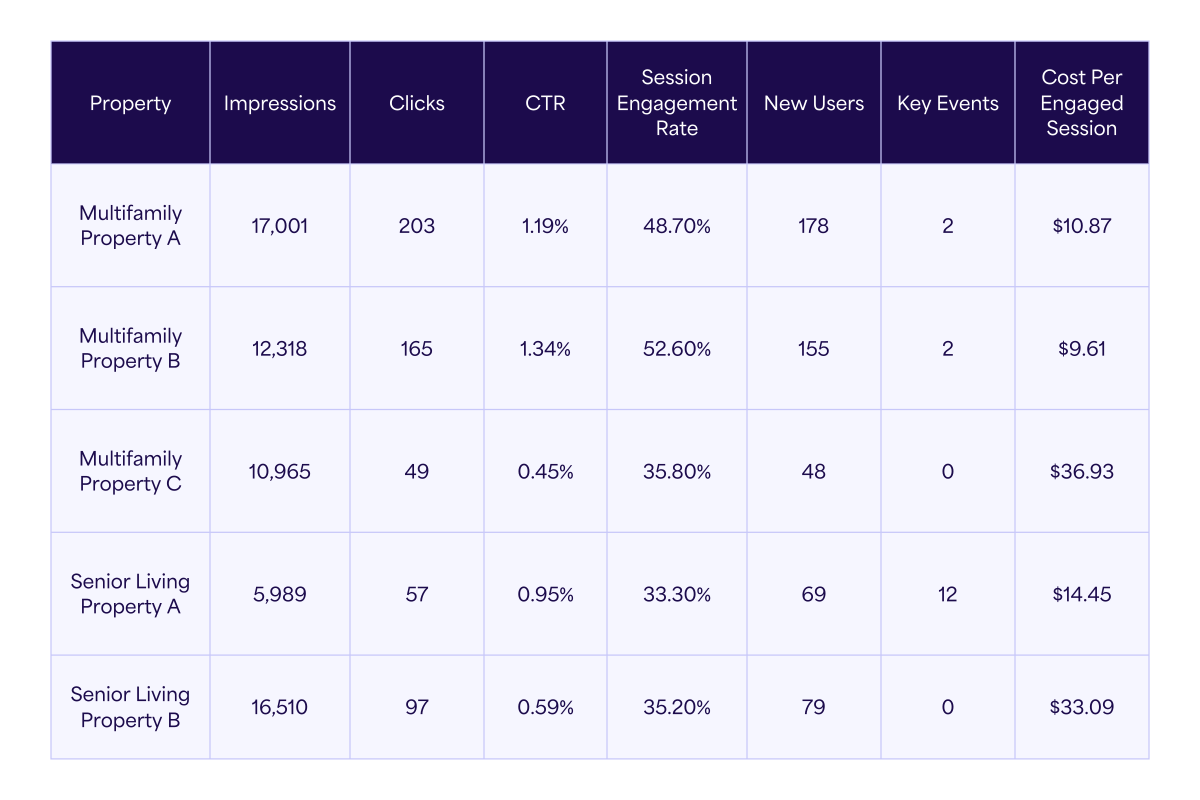
Here is a full breakdown of how the five campaigns performed.
ChatGPT Ads Drove New Site Visitors at High Engagement Rates
ChatGPT advertising generated 529 new website users from five relatively small tests. That demonstrates there is at least a real, measurable audience available through the channel.
This audience also shows high engagement once they land on the property website. When looking at the engagement rate in Google Analytics for traffic from these campaigns, the results were strong for a paid media channel. The engagement rates outperformed four out of five of the properties Meta campaigns and all of the properties Instagram and Display ad campaigns.
Engagement rate is the percentage of sessions that were considered engaged (sessions that either lasted 10 seconds or longer, include 2 or more page or screen views, or trigger at least one key event).
It’s important to note that despite the engagement rates being higher for ChatGPT Ads, these properties’ Meta campaigns still generated dramatically higher key event conversions, making Meta a much better channel for direct conversions. Meta, Instagram, and Display also drove higher session volumes at lower costs.
Broader Residential and Senior Living Focused Ad Groups Performed Better
Broad, location-anchored ad groups consistently beat narrow, product-specific ones in both verticals. Multifamily Property B’s neighborhood-themed ad group hit a 1.54% CTR versus 1.06% for its floor plan-focused group, and Senior Living Property B’s general senior living group delivered clicks at roughly a third of the cost of its memory care group.
CPC Bidding Limited Ad Delivery But Kept Down Costs
The bidding model made a difference in how expensive traffic was to acquire and how engaged the traffic was.
The cost per GA4 session for properties running CPC bidding was less than half that of properties running CPM bidding ($4.63 vs. $10.06), and so was the cost per engaged session, at $12.03 vs. $26.96.
Properties running CPC bidding tended to spend less of their budgets due to the CPC caps in place, but, interestingly, they also averaged a higher CTR (1.15%) than properties running CPM bidding (0.74%).
Should your multifamily or senior living community run ChatGPT Ads?
Before recommending a brand-new ad channel to any client, we hold it to the same standard as every other channel. That meant answering these key questions:
Do ChatGPT users who see these ads actually click?
Yes, but we found the click-through rates to be much lower than other channels, especially Google Search Ads and Meta Ads, and more similar to Display Ads. We saw higher CTRs for multifamily properties (0.45-1.34%) than for senior living (0.59-0.95%).
What does the quality of that traffic look like?
While the traffic volume was lower than other channels, the overall campaign session engagement rate was often higher (ranging from 33% to 53%).
Engagement rates for Multifamily Property B were really strong and ranged from 48-72% (depending on the ad group), outperforming the property’s Facebook (35%), Instagram (15%), and Data-Driven Display (13%) traffic. Multifamily property B’s overall cost per engaged session was $9.61, the lowest across the test.
And are there early signs that the channel can drive valuable conversions?
We didn’t find ChatGPT’s native conversions metric helpful for determining whether conversions were high-quality, so we used our own key event tracking in Google Analytics instead. We tracked events like schedule a tour, submit contact form, call, email, chat with the property, and apply now.
Of the five properties, three had key events. Senior Living Property A had the most at 12 key events, Multifamily Property A and Multifamily Property B had 2 key events each.
Should marketers move budget from other channels into ChatGPT?
We wouldn’t recommend taking meaningful budget away from proven channels based on these results, but we would recommend carving out budget to test properties where generating incremental qualified site traffic is valuable, such as lease-ups, competitive submarkets, or properties with occupancy pressure.
What We Plan to Test Next
We plan to run a second round of tests for a larger sample of multifamily and senior living properties.
We’ll explore the following platform features next to enhance targeting, control costs, and improve ad delivery:
- Bid types. We’ll keep testing CPC against CPM and try the Conversion Optimized CPC bid type to see which delivers the best balance of ad delivery, budget pacing, conversions, and cost.
- AI-generated vs. manual ad groups. ChatGPT Ads targets by topic descriptions (“context hints”) instead of keywords, and the platform’s AI can write them for you. We’ll test those auto-generated hints against ad groups we create manually to see which pulls in better-qualified traffic.
- First-party audiences. We’ll upload a lead or resident list as an audience segment to test whether it improves engagement and traffic quality.
Want to be the first to learn about the next round of results? Subscribe to the CLX newsletter.
